Monday, October 21, 2013

GENERAL AUDIENCE WITH POPE FRANCIS


Wednesday 9 October 2013

GENERAL AUDIENCE WITH POPE FRANCIS


Any event involving the Pope is going to be an exercise in patience and crowd control. I experienced this in 1987 when Pope John Paul II visited San Francisco, and again in 2002 at Toronto for John Paul’s final World Youth Day. And now, here I am at the Vatican with over 70,000 other people at St. Peter’s Square, waiting patiently for an audience with the new Pope Francis. This is very exciting and one can feel the electricity in the air.

Our group left the hotel early at 7:00am to get good seats in the Square. At least we thought it was early. By the time we arrived at St. Peter’s half an hour later, the crush of people was overwhelming. All thoughts of good seating went out the window as we stood shoulder-to-shoulder in a sea of humanity for what seemed like an eternity. The line was not moving at all, and I was starting to get claustrophobic. So I pulled out my Rosary and prayed silently through two sets of mysteries (the Joyful and the Luminous) before we finally cleared the security checkpoint.

We hurried quickly through the back section of the Square and my heart sank with the realization that we might be on our feet for four hours. There were no chairs here in what was obviously a standing-room-only section. But then, we looked ahead and saw two of our friends, Bill and Ann Christman, waving from the top of plastic chairs in the middle section. Yay! We ran over, happily took our seats and settled in for the long wait. (I joked with Bill and Ann later that they were obviously experienced in finding good seats at festival rock concerts!)

The time was now 8:00am and the Papal Audience was scheduled to begin at 10:30. It started raining, of course, and out came the umbrellas. I’m an Oregonian so I don’t do umbrellas. I just put on my woolie hat and my rainproof windbreaker and sat out the precipitation. I had been waking up at 4:00am every day of our trip, so I easily fell into a deep nap, rain and all.


When I awoke 20 minutes later, a warm shining sun nudged us into removing our coats. The empty reserved chairs in front of us were filling up with a very large and loud group. Based on their red and white flags, I surmised they were from Malta, an island nation on the Mediterranean, south of Italy.

Suddenly, an emcee’s voice resounded over the loud speakers. In Italian, he was introducing the various groups of pilgrims, who each cheered loudly and waved their flags when they heard their names. It was not a bad way to keep the crowd occupied during the long wait. When an English-speaking emcee took the microphone, our group sat up in anticipation as he announced groups from Britain and Australia and the United States. After several minutes, we were disappointed when the Italian emcee returned. Our name was not announced but we cheered anyway.


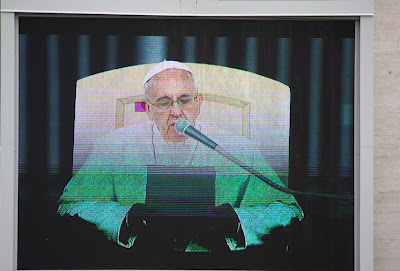
I looked at my watch and it was 10:00. The entire crowd erupted into a loud cheer as people stood on their feet. The big-screen TV monitors revealed the reason: Pope Francis had arrived! There he was, standing in his open-air Popemobile as it drove slowly through the Square. He was smiling broadly as he blessed the crowd, reaching out to shake hands and kissing babies who were brought up to him. The Holy Father’s magnetism was electrifying and not even dampened by the pouring rain. Our cameras were snapping away and a few of us got some terrific shots as he drove past us. Around 10:30, the Popemobile arrived in front of the basilica and Pope Francis took his seat on a platform underneath a canopy.


By its very nature as a multi-lingual event, a General Audience of the Pope follows a very structured format. After an opening prayer, a reading from Scripture is proclaimed — today from the Gospel of John, chapter 17: Christ’s prayer for unity. The Holy Father then shares his reflections on this Scripture passage in Italian. He is followed by several cardinals representing several cultural groups as they speak in Arabic, Croatian, English, French, German, Italian, Polish, Portuguese, and Spanish. Each cardinal thanks the Holy Father in the name of his cultural group, then gives a summary of the Pope’s talk in his group’s language. That is followed by brief remarks from Pope Francis geared specifically to each group, who hear a translation afterward by their cardinal. Because of the many languages involved, it takes some time for this process to unfold. After the final group has been addressed, we all stand and join the Holy Father in singing the Lord’s Prayer in Latin. He then concludes the General Audience by giving us his Apostolic Blessing.

This structure sounds very formal on paper but, as can be seen from the video below, Pope Francis often put his paper down and spoke to us from his heart. Today his message centered on Unity with Christ, and how the rich diversity of the Church is a true blessing from God. “Our differences make the Church beautiful,” said the Holy Father.


Our audience with Pope Francis was a shared experience that we will treasure always. Here are some links to his prepared text, plus a terrific video with English subtitles.


Click here for official English text of the Pope's remarks from our General Audience (Vatican website).


Click here for the complete coverage of our General Audience from Rome Reports.


Special thanks to Mike Strassmaier for his awesome photos! Here are a few more . . .


ST. PETER’S BASILICA and the SISTINE CHAPEL


Tuesday 8 October 2013


ST. PETER'S BASILICA

We’re on a pilgrimage, so I try to pray at all the holy sites that we visit. That prayer has sometimes been deep and powerful — for example, at the tombs of St. John and St. Paul. But after our morning liturgy at St. Peter’s, when we returned to the basilica with our tour guide Paolo, it felt more like we were at a museum than at a house of worship. That’s not the basilica’s fault. St. Peter’s, covering about 15,500 square yards and reaching up 150 feet high, is overwhelming, historic, and very much a product of the Renaissance style from which it was birthed. Around 7 million people come to St. Peter’s annually, making it among the most visited sacred sites in the world. So, of course, the basilica will be crowded, busy and noisy on any given day.


All the churches and mosques we have visited are covered almost wall-to-wall with beautiful art or — in the case of the mosques where no images are allowed — exquisite architectural design. St. Peter’s magnifies that art-sharing a hundredfold. Its ornate columns, gold-leafed walls, paintings and statues were created by a Who’s Who of the Renaissance era: Raphael, Brunelleschi, Bernini, Michelangelo, and more. The obvious response from visiting pilgrims is jaw-dropping awe and camera snapping, plus a fair amount of pushing and shoving, especially at popular areas like the Pieta or the Tomb of Blessed Pope John XXIII. In large crowds I start praying the Rosary silently. I find that it calms me and centers me, and on a pilgrimage it keeps me focused on the reason I am here.


I often hear comments from people along the lines of, “Such opulence! The Church should sell these treasures and give the money to the poor.” I admit I sometimes had that viewpoint when I was younger but I have since come to a more thoughtful understanding of the art and architecture of the Vatican.

1. These statues, paintings and buildings were commissioned by the Church during the Renaissance from the finest artists of the day. They are true works of art that reflect the baroque “over-the-top” style of that period — perhaps not the artistic cup of tea for many people of the 21st century but certainly worthy of preservation for future generations.
2. If the Church were to sell these art treasures, who would buy them? What would happen to them? Would the new owners (assuming someone could actually afford them) continue to share them with the public for the whole world to see? Would they be displayed in a respectful setting that would inspire visitors to prayer and faith?
3. Why is the Catholic Church always singled out with this question? The Anglican Westminster Abbey in London is filled with paintings and tapestries that attract millions of visitors annually. As we saw in Turkey, the Muslim faith also has relics and sacred treasures on public display at Topkapi Palace, not to mention the magnificence of the Blue Mosque. One never hears criticism of these sacred places. In fact, the Muslim community utilizes the Topkapi display of its sacred treasures as an opportunity to edify the faithful, and to educate people who might be curious to learn more about the teachings of the Prophet Mohammed. So the Catholic Church isn’t the only faith community to understand and appreciate the value of sacred art.

Here are a few more photos of the sacred art of St. Peter’s Basilica:


Click here for the official Vatican website on St. Peter's Basilica.


+ + +     


THE SISTINE CHAPEL

We were in St. Peter’s for only 90 minutes. I could have spent a whole week! But now it was time to move on to the Vatican Museum, which climaxes at the incomparable Sistine Chapel.

Seemed like the museum entrance was at least two miles away from St. Peter’s Square. More walking, more waiting in long lines. Along the way I was very amused to see a restaurant with a clever name that is a play on “Habemus Papam,” the Latin words used to announce the election of a new Holy Father (“We have a pope!”).


The Vatican Museum is basically a “stage wait” that leads to the REAL event: the Sistine Chapel. That’s not to denigrate the beautiful art that precedes the museum’s climax — everything from ancient Roman statuary to medieval tapestries to Renaissance ceiling frescoes. . .


But anticipation for the Sistine Chapel was certainly high as we eagerly awaited our chance to set foot in that renowned sacred space. Briefly, it’s the chapel of the Apostolic Palace, the official residence of the Pope. It takes its name from Pope Sixtus IV, who began the chapel’s restoration in 1477. Perhaps the most definitive renovation was Pope Julius II’s commissioning of Michelangelo to paint the ceiling frescoes in 1508. Later, Pope Paul III commissioned the artist to return and paint the frescoes of Last Judgment over the altar in 1535.

I was in awe as we entered the chapel, which was wall-to-wall with a hushed crowd of people. Photography was NOT allowed. In fact, one young man who snapped a photo was promptly removed by security. So the images I share below are lifted from official photos from the Vatican website.


I walked away with a deeper appreciation for the intricate artistry of Michelangelo, who spent fours years lying on his back on top of scaffolding. That he was able to create a masterpiece under such challenging circumstances staggered my imagination.

The Sistine Chapel is, of course, renowned as the location where the College of Cardinals holds the Conclave that elects a new pope. We saw this most recently with the election of Pope Francis last spring (March 2013). But if you missed seeing that on television, I highly recommend that you check out the 1968 movie The Shoes of the Fisherman starring Anthony Quinn as a the first Russian pope. It is perhaps the most vivid cinematic portrayal of the ritual and traditions of the Papal Conclave, and the Vatican gave permission to the producers to film right in the Sistine Chapel. Absolutely fascinating and educational!


Click here for a link to the Shoes of the Fisherman DVD on Amazon.

Click here for more detailed info on the Sistine Chapel from the website of the Vatican Museum. Includes virtual tour of the chapel.

NEXT BLOG: General Audience with Pope Francis.


Friday, October 18, 2013

MASS AT ST. PETER'S


Tuesday 8 October 2013

MASS AT ST. PETER’S      


Midway through our journey, we arrived at the place that many would consider as the high point of our pilgrimage: St. Peter’s Basilica!

Our cameras were snapping away as soon as the basilica dome became visible from our bus. We left the hotel early to beat the traffic, and there was definitely an excitement in our group as we crossed the quiet streets leading to St. Peter’s Square. I have many well-traveled friends who have told me that all Catholics need to make a pilgrimage to the Vatican but I never thought that I would ever actually be able to do so. And here we were, getting ready to celebrate Mass with Father Paul in the basilica itself!


I think we were all in awe as we set foot in St. Peter’s Square, whose images are so deeply ingrained in our Catholic memory from the many papal events of our lifetime: the white smoke from the Sistine Chapel; the blessing of newly elected popes from the balcony; the impressive funeral of Pope John Paul II; the General Audiences; and so much more. The façade of the basilica is certainly imposing: 376.3 feet wide and 149.4 feet high, with thirteen statues looking down on us – Christ, surrounded by the Apostles (except St. Peter, whose statue is left of the stairs) and St. John the Baptist. The inscription below the cornice commemorates the pope who oversaw the completion of the Renaissance-era construction that replaced the old 4th-century basilica:

IN HONOREM PRINCIPIS APOST PAVLVS V BVRGHESIVS ROMANVS PONT MAX AN MDCXII PONT VII

(In honor of the Prince of Apostles, Paul Borghese, a Roman, Supreme Pontiff, in the year 1612, the seventh of his pontificate)


But it was time for us to stop our gawking and head into the basilica. We were already late for our scheduled Mass at the side altar. We rushed through the initial security screening easily enough but I hit a roadblock at the basilica’s front door.

I was told that guitar cases are routinely turned away at the doors of St. Peter's but, as my pilgrimage friends know, my guitar folds in half and my case looks more like a backpack. The front door guard looked me over and said in a thick Italian accent, "What is that?" 

I replied honestly, "It’s a guitar, for my group's Mass." By this time, most of our group had gone ahead of me to set up for the liturgy. Luckily, Mike Strassmaier and Art Nutter were still with me.

"Do you have permission slip to play guitar at your Mass?" asked the guard. 

"What permission slip?" I asked innocently. Then one of our group ran back to me.

"Come on, Ken! Fr. Paul is ready to start Mass!" 

The guard became concerned. He was actually very nice but he needed to make sure this was cleared with his supervisor. "Don't be late for Mass. But first go to sacristy and get permission from Head Usher."

So off to the sacristy we went. St. Peter's Sacristy is like Grand Central Station, with nuns and seminarians assisting visiting priests and bishops who want to celebrate various side altar liturgies. Oscar, our tour guide, had now joined our permission party and he explained our request in Italian to the Head Usher, who sized me up and said one emphatic word:

"No!"

Then Oscar explained that my guitar is not electric and I would strum softly. We were already late for Mass. Our guide pointed to his watch and pleaded with the Head Usher, who finally relented and granted permission. And that is how I ended up playing guitar for Mass at the Vatican! My fellow liturgists and composer peers are still in awe by the story of how I got away with this. It was a classic case of "Better to seek forgiveness later than to ask for permission now."


8:00 am is obviously Mass time at St. Peter’s. There were several pilgrimage liturgies taking place simultaneously throughout the basilica at the various side altars. We dashed out of the sacristy a little disoriented as we looked for our group. Then Mike heard Fr. Paul’s distinctive voice over the church sound system and we followed his voice to the Altar of the Chair of St. Peter.

My jaw dropped as I realized that our Mass was not at just any side altar. We were at THE side altar, the Cathedra Petri, behind the Pope’s main altar. Father Paul attended seminary here in Rome and this pilgrimage is a celebration of his 50th anniversary as a priest. How utterly fitting that he would return to the Vatican to celebrate this personal landmark! How privileged we were to be with him!


Our priest’s homily was incredibly moving, and I hope I can do it justice in this blog. Father Paul recalled his special day as if it were yesterday. His father, a convert to Catholicism, prepared a wonderful surprise gift: he spent the better part of a year learning Latin so he could be an altar server at his son’s First Mass! It was with great joy that father and son walked down the aisle together as the newly ordained priest celebrated his first Eucharist with family and friends.

As St. Peter said to Jesus at the mountain of the Transfiguration: “Lord, it is good for us to be here!”

NEXT BLOG: More on St. Peter’s Basilica and the Sistine Chapel


Wednesday, October 16, 2013

CHURCHES OF ROME


Monday 7 October 2013


CHURCHES OF ROME

Last night, after our wonderful walk through St. Paul Outside the Walls, we settled into our hotel. After dinner we took in an enchanting “Rome by Night” tour of the City, led by our knowledgeable guide Paolo. Marvelous!


Today, we did a whirlwind tour of Rome that left many of us out of breath. So many churches! So little time!

+ + +

PAPAL BASILICA OF SAINT MARY MAJOR
(Basilica di Santa Maria Maggiore)


As mentioned in my previous blog, this is one of four major basilicas in Rome, the other three being St. Paul Outside the Walls, St. John Lateran, and St. Peter’s. By way of definition, a basilica is a church that has been designated as a Catholic pilgrimage site. A papal or major basilica is so-named because it is often visited by the Pope for special occasions and has the distinction of having a Holy Door that is opened by the Holy Father only during the Holy Year or Year of Jubilee. Next Holy Year is 2025.


St. Mary Major was built by Pope Sixtus III (432-440) and is the largest Marian shrine in Rome. Among its many art treasures is the Reliquary of the Nativity – a relic of the Manger of Baby Jesus. I once again found myself kneeling in emotional prayer before a relic with tangible ties to our faith.


Click here for a brief historical summary of this basilica.


We would return to St. Mary Major for Mass on Wednesday.

+ + +

CHURCH OF THE GESU


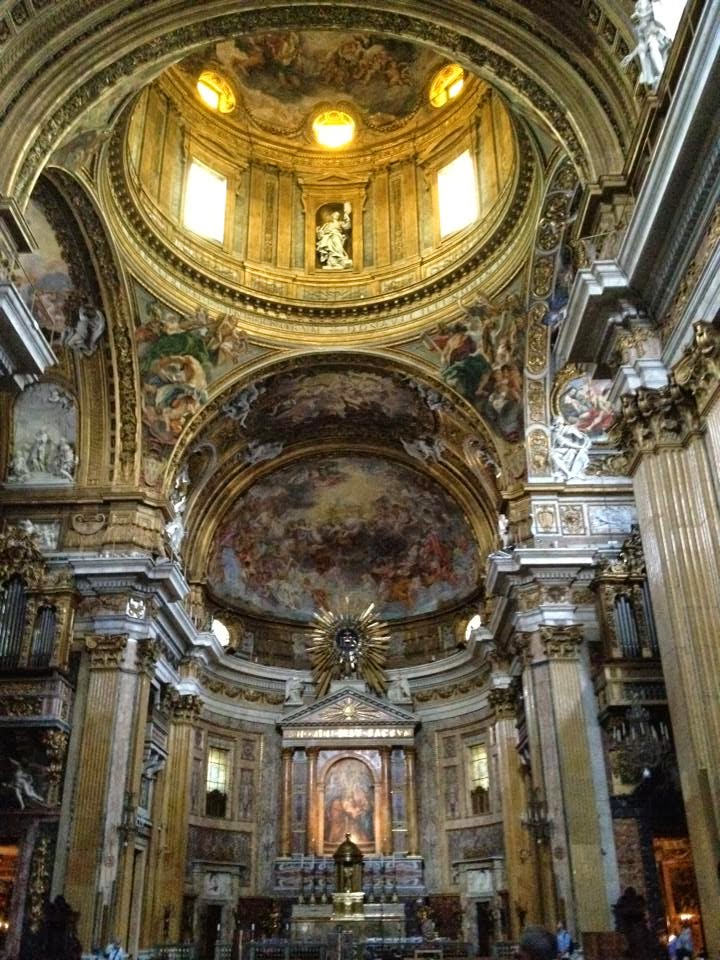
Chiesa del Gesù is the Mother Church of the Jesuit religious order, also known as the Society of Jesus, founded by Saint Ignatius of Loyola to carry out a ministry of education and evangelization. Our current Holy Father, Pope Francis, is a Jesuit.

Church of the Gesu was consecrated in 1584, and its design set a pattern for Jesuit churches that lasted well into the 20th century. Among those design features:

  • ·      No narthex in which to linger;
  • ·      immediate entry into the body of the church;
  • ·      single nave without aisles so a visitor’s attention is focused immediately on the high altar;
  • ·      in lieu of side aisles, a series of interconnecting side chapels with high arches.


In addition to the essential Catholic iconography of Jesus and Mary, there is an obvious emphasis on images, statuary and relics of Jesuit saints: Ignatius Loyola, Francis Xavier, Robert Bellarmine, and more.


Official website of the church: www.chiesadelgesu.org

+ + +

BASILICA OF SAINT CLEMENT
Basilica di San Clemente al Laterano


A minor basilica dedicated to Pope Clement I, the original church was built in the 4th century and is accessible below the current church, which dates from 1123. The ancient underground church was originally a private home in which Mass was celebrated secretly to avoid Roman persecution.

Although the San Clemente’s outside façade is humble and unassuming, the interior is among the most richly adorned churches in Rome. When we entered the church there were many Dominican priests and brothers chatting with diocesan seminarians. Irish Dominicans have been caretakers of San Clemente since 1667, when England outlawed the Catholic Church and expelled the clergy. Pope Urban VIII gave them refuge at San Clemente, which has become a residence for the order’s seminarians in Rome. The Dominicans oversaw the excavation  and restoration of the lower level in the 1950s.


On a personal note, although I was deeply touched by the history of the crypt and its connection to Christian persecution, I was unprepared for the length and depth of the ancient tunnels. I am claustrophobic and soon found myself hyperventilating when it became clear that we were going to be underground, without windows, for a significant time. I held my fear in check so as not to cause panic or concern among my friends, but bolted straight out to the courtyard when we eventually found our way back to the gift shop exit. Whew!


Official website:


+ + +

COLOSSEUM

We somehow squeezed in a quick tour of the legendary Roman Colosseum, a true marvel of engineering in the pre-technology age. Walking through the interior, I was struck by how closely today's football and baseball stadiums still follow this ancient design.

Despite their advances in government, culture, engineering and architecture, the Romans were a brutal society. According to tradition, bloody gladiator battles took place here and, during "halftime," Christians were fed to the lions. So this is a holy site of Christian martyrdom during the terrible persecution of Emperor Nero.

In retrospect, if Christians were so willing to die for their belief in Jesus Christ, then the Roman Empire was doomed. In just 300 years, Christians conquered Rome without an army as Emperor Constantine issued the Edict of Toleration.


+ + +

SCALA SANCTA (HOLY STAIRS)


By tradition, these are the steps that led up to the Praetorium of Pontius Pilate in Jerusalem, on which Jesus stood as he awaited trial during his Passion. The stairs were brought to Rome by Saint Helen in the 4th century and are housed in the old Lateran Palace opposite the Basilica of St. John Lateran. As a sign of devotion, pilgrims climb the 28 marble steps (now encased in wood) on their knees as they prayerfully approach the Holy of Holies, a private chapel of the early popes that contains a relic of a fragment of the table on which the Last Supper was served.


+ + +


PAPAL ARCHBASILICA OF ST. JOHN LATERAN


Quick question: What is the Mother Church for Roman Catholics? If you said St. Peter’s Basilica you are not quite correct. The distinction goes to the Archbasilica of St. John Lateran, the cathedral church of the Diocese of Rome. Since the Pope is the Bishop of Rome, this is his cathedral. It’s a little confusing but that does not lessen the importance of St. Peter’s. Before the rise of the modern papacy and the Pope’s global mission, his original ministry was as bishop for the people of Rome.


Consecrated in the year 324, the Lateran Basilica has survived fires, decline, and even a controversial “second papacy” in Avignon, France. When the papacy returned to Rome in 1378, St. John Lateran was in such deterioration from the damaging fires that it was deemed inadequate to serve the Pope. That partially explains the rise of St. Peter’s Basilica as the papal church, even though the Lateran Basilica remains the Pope’s official cathedral.

Reconstruction and restoration began in earnest, resulting in the unveiling of the magnificent statues of the Apostles in 1718.


We concluded our very busy Monday with Mass in one the side chapels. Our already large group increased in size considerably when word got out among other tourists that Fr. Paul was presiding at an English Mass. We were pleased to welcome new friends from New York and Germany. 


Virtual Tour of the Lateran Basilica: (a “must-see” website!) www.vatican.va/various/basiliche/san_giovanni/vr_tour/index-en.html


TOMORROW: St. Peter’s Basilica!