Tuesday, October 8, 2013

EPHESUS: THE ANCIENT CITY


Friday 4 October 2013
EPHESUS: THE ANCIENT CITY


Airport. Again? This is my 41st flight of the year, and we're heading toward Ephesus, legendary biblical city where Saint Paul established a Christian community, Saint John was imprisoned, and where Jesus' mother Mary came to live out  her final years.

But first, Istanbul Airport. I was surprised to discover that security screening is the very first thing to do upon entering the front doors of the terminal. Ticket counter follows. No prob. Off come the belt, the metal, the electronics. Yawn. So routine for me now. We presented our passports, received our tickets, and then -- surprise! Second security screening! Off came the belt, the metal, the electronics. Again??

Anyway, after a 45-minute flight over beautiful rural land and blue water, we landed in the ancient city. Saint Paul's famous letter to the Ephesians is often the first thing that comes to mind after hearing the word "Ephesus," but a lot more happened here than the Epistle.


The Romans had a significant presence in Ephesus. They took over the region from the Greeks and built a city that included administrative and parliamentary buildings, the Library of Celsius, a 25,000-seat amphitheater, and a bath complex equipped with one of the most advanced aqueduct systems in the ancient world. The city also housed the Temple of Artemis, one of the Seven Wonders of the Ancient World.


I was unprepared for the immensity of the ruins site, nor did I know how well preserved the structures were. No completely whole buildings but just enough from which to picture the original splendor in the mind's eye: a facade here, an arch there, or several neatly laid out columns. The Library of Celsius was especially impressive with its facade, statuary, archways and ornate columns preserved almost intact.


It was a thrill to stand on center stage at the amphitheatre. I could almost hear the 25,000 spectators in those carved out seats, applauding a Greek tragedy or cheering wildly at bloody gladiator games.


This was definitely a ruins site, as underscored by the treacherous walking conditions. Centuries of erosion have rendered formerly smooth marble walkways into an uneven and slippery obstacle course. One had to walk gingerly so as not to twist an ankle, or worse. Stairways were especially challenging, with no handrail to lean on. And yet, our guide Aran kept pushing us forward at a quick pace.


That said, the Roman ruins were definitely an exciting highlight of the pilgrimage that helped me put Ephesus into historical context.

+ + +

BASILICA OF SAINT JOHN THE APOSTLE

John, the Beloved Disciple, figures largely in the history of Ephesus. Years after the Resurrection and Ascension, John settled down into the region. Legend has it that John brought Jesus' mother to Ephesus to fulfill his Lord's crucifixion request to care for Mary after the great Paschal events. She settled into a modest cottage now known as the House of the Virgin Mary. (More on that later.)

John founded a vibrant Christian community in Ephesus. The eloquence with which he expressed the words of Jesus in the gospel that bears his name implies that John himself must have been a dynamic preacher. He was briefly imprisoned by Emperor Domitian on the Island of Patmos, where tradition says he wrote the Book of Revelation, whose symbolic apocalyptic imagery has been so widely misinterpreted over the ages.


The ruins of the Basilica of Saint John date stand as an apt testimony to the successful establishment of the Johannine Christian community, which built a small church on this site, most likely in the late 90s to early 100s AD. The original church fell into disrepair but Emperor Justinian built a new, larger church over the site in 550.


The assembly area is very large. The baptismal font, shaped as a cross, was built for immersion, and the stairways on both ends allowed the baptism candidates to walk into the water, be symbolically buried in Christ, and walk out to new life. All this was impressive enough but I was unprepared for the emotional impact of coming upon Saint John's Tomb.


I started trembling. I could only kneel down on the dusty ground and pray silently as Jesus' "I Statements" from John's gospel flooded my brain and heart.

I am the bread of life . . . I am the resurrection . . . I am the way, the truth, and the life . . . I am the Good Shepherd . . .

Plus, the incomparable poetry of John's prologue: 

In the beginning was the Word,
and the Word was with God,
and the Word was God. . .

I knew that Saint John is not really buried here, but I was more overwhelmed by the faith of the Johannine community who chose to honor their spiritual father by setting up a tomb for his veneration. John is not buried here? Allow me to explain. 

Many religious legends surround the death of Saint John. He allegedly received a vision of Jesus toward the end of his life in which the Lord told him, "Soon, my friend, you will join me at the Table with your brother apostles." The following Sunday, he led his own disciples to the cave in their church to pray. But a great light blinded the disciples and prevented them from entering. The light dissipated and they discovered that John was gone.


Nevertheless, there is a tomb ascribed to John at his basilica in Ephesus. Excavation over the years has revealed no evidence of bodily remains. Consider that throughout the Christian world, relics exist for all the Apostles except John. It would seem that the Beloved Disciple, to whom Jesus entrusted the care of his mother, shared with her in the blessing of bodily assumption after death. 


There were also many other things that Jesus did, but if these we to be described individually, I do not think the whole world would contain the books that would be written.
-John 21:25


+ + + 

HOUSE OF THE VIRGIN MARY


We concluded our incredible day in Ephesus with a visit to the House of the Virgin Mary (in Turkish: "Meryem Ana Eri").

In John's Gospel, Jesus entrusted his mother to his Beloved Disciple. According to legend, John brought Mary to Ephesus. She lived out the remainder of her days in a modest cottage.


The house was discovered in the 19th century by following the descriptions on the visions of Blessed Anne Catherine Emmerich, who was beatified by Pope John Paul II. None of this can be proven, but the lived faith of the hundreds of thousands who have visited the House of Mary does not require proof. 

We each spent time in prayer in that humble house. We followed that with a Mass in the outdoor chapel. Songwise, we started out with "Prayer of St. Francis" since October 4 is the Memorial of St. Francis of Assisi. We also sang "For the Sake of Christ" as a nod to St. Paul's ties to Ephesus. For Communion, we sang "I Am the Bread of Life," based on John 6, since John figured into our incredible day. Lastly, we sang "Immaculate Mary" because we were at Mary's House. God is good!


+ + +

BONUS: Here is a snippet of the Pegasus Airlines safety video that we saw on the flight from Ephesus to Istanbul. Funny and cute! (Note: Video is only viewable on the web version of this blogsite.)


Sunday, October 6, 2013

PRAYING FOR PEACE


Thursday 3 October 2013

PRAYING FOR PEACE


We began the day with Mass at the Basilica of St. Anthony of Padua, the largest Catholic church in Istanbul, somewhat hidden away in an alley off Istiklal Caddesi, a major downtown thoroughfare where the Streetcar runs. I was surprised to see how European the church architecture is. Built in 1912, the architect was Italian, as are the priests who still serve the parish today.


The church interior is perhaps best described as traditional "cathedral gothic" -- long aisle, high ceiling, dark lighting, with many statues along the side walls. A statue of Mary and a crucifix adorn the center of the sanctuary, and the tabernacle is off to the right at a side altar, underneath a large painting of the Last Supper. 

There was another tourist group in the church celebrating Mass in English with their bishop. We watched them from the back for a few minutes, then went downstairs to what I thought would be a brief waiting period. "Coffee and donuts?" I joked.


I was surprised to discover a basement chapel below the main church, complete with its own ornate sanctuary, altar, pews, tapestries, stained-glass windows. I quickly re-assembled my travel guitar (more on that later) and set up a small table in front of the pews on the left side to serve as a makeshift music stand.


In his homily, Fr. Paul spoke of the need for us to be peacemakers. I couldn't help noticing the two stained-glass windows behind him. To his right, Blessed John XXIII, who wrote the papal encyclical, "Pacem in Terris" (Peace on Earth). And to his left, Blessed John Paul II, who promoted peace during his world travels and was instrumental in the fall of the Communist Soviet Union. So for Sending Forth, we sang my song, "Grant Us Peace."


+ + + 

CHURCH OF THE HOLY SAVIOR IN CHORA

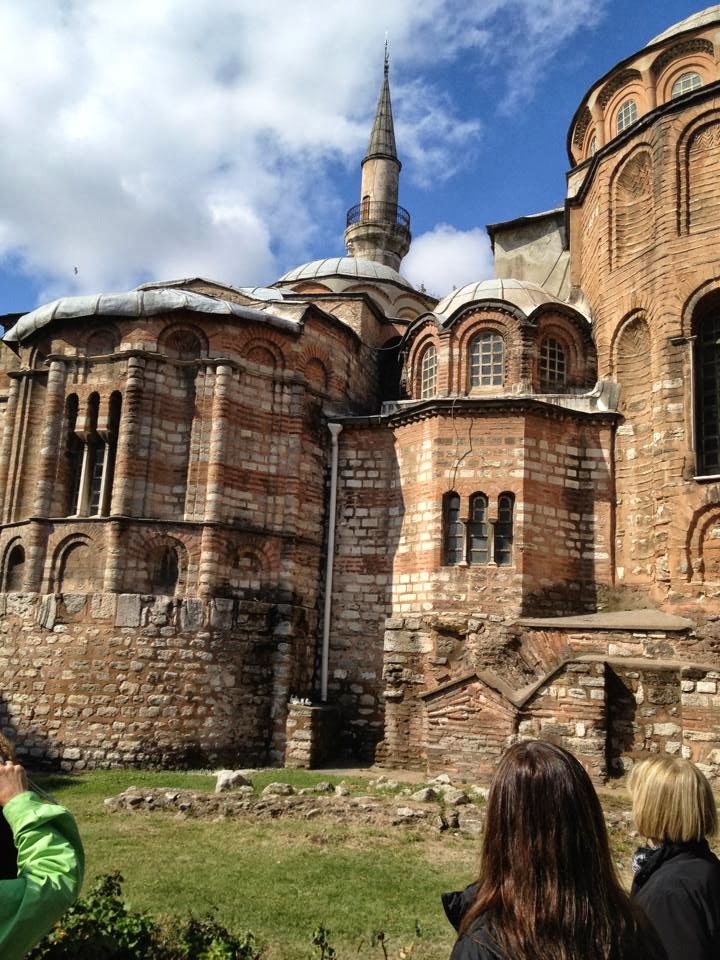
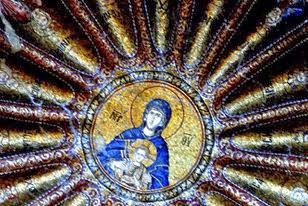
There is an old Orthodox church in the Edirnekapi neighborhood of Istanbul called the Church of Holy Savior, or simply Chora Church. Built of brick with high ceilings and six domes, just about every inch of wall or ceiling is covered with breathtaking Byzantine mosaics. Chora Church is basically a wall-to-wall walk-through icon exhibit.


This house of worship, like many in Turkey, has changed denominations over the centuries. Established in the 5th century as an Orthodox church, Chora became a mosque in the 16th century because of Ottoman conquest of the region. It became a museum in 1958 and is a national treasure.

The important stories and people of the New Testament are portrayed in these mosaic frescoes:


Jesus Christ
Virgin Mary and her life
Christmas story
Miracles of Jesus
St. John the Batist
St. Peter, St. Paul, other Apostles
Heavenly host of angels
Second Coming


The frescoes are in a state of arrested decay. They were plastered over during Chora's mosque period, but restoration work began in 1948. Occasional blank spots testify to centuries of wear and tear but the mosaic brilliance still shines through. A walk through Chora Church is certainly a pleasant and inspiring way to spend the morning.

+ + +

NEO??

After the fabulous Chora tour, I was sitting at the steps of the outdoor cafe next to the church when a very familiar black cat approached and sat at my feet. I did a double take.


"Neo?? How did you get here? How did you find me?"

Surely, this was not my cat. Nevertheless, I looked for Neo's unique puff of white hair below this cat's chin. Nope. Of course not! But why was this cat so friendly to me? Maybe Neo sent him to check up on me?

Yeah, this is silly. But what a coincidence!

+ + + 

GRAND BAZAAR

So with 90 minutes of free time to kill, we went to the world famous Grand Bazaar. At least everyone was telling me it's world famous. I had never heard of it before, but the moment I stepped into this overwhelming cavern of shops and booths I was hit with an air of familiarity. I had seen this place before -- in movies and on TV. In fact, Kamio informed me that an episode of The Amazing Race happened here.


Established in 1455, the Grand Bazaar is the largest and oldest covered market in the world, with 61 covered streets, 3000 shops, and 300,000 visitors daily.  I hung out with Mike and Kamio. We agreed we weren't interested in buying anything but it would be fun to browse around. And we were hungry for lunch. We found a food court with several sidewalk cafes and were immediately accosted by waiters and managers who forced brightly colored menus into our faces.

"Hungry?"

"There is table just for you!"

"Just look at this menu! Delicious!"

"Welcome to your place!"

It was very overwhelming but we settled on a restaurant based on the color of the booths (orange). We ordered and shared a vegetarian pizza bread and it really was quite tasty.


+ + + 

CRUISING THE BOSPHORUS


And now for something completely different! We boarded a ferry at the waterfront and took a leisurely 90-minute cruise down the Bosphoros Strait, passing beneath two imposing suspension bridges: First Bridge (completed 1973) and the Fatih Sultan Mehmet Bridge (1988). Design-wise, First Bridge is a spitting image of the Golden Gate Bridge except it's grey, not orange. The Mehmet Bridge might pass as a cousin of the Oakland Bay Bridge (San Francisco span).


It was a chilly and windy afternoon but many of us braved the outdoor decks anyway, cameras flashing away. As per trite custom on any boat of any size, I went to the bow, stretched out my arms, and yelled, "I'm the king of the world!"

The friendly crew started serving drinks and, given where we were going the next day, I ordered the local beer, Efes (Turkish for Ephesus). As we settled down at our tables, we enjoyed an impromptu episode of "Lifestyles of the Rich and Famous" as our guide Aran gave us a running commentary on the many good-looking mansions that lined the shoreline on both sides of the water -- the Asian side and the European side. 


At one point, Aran pointed to the hills on the Asian side and said, "Chalcedon! City of the Council of 451 that helped to fine-tune the Church's understanding of the dual nature of Christ." Yes, the city still exists but, unfortunately, there is no church or landmark to commemorate the council. So we waved to the hills.

All in all, a wonderful way to end an awesome day!

Next blog: EPHESUS


Saturday, October 5, 2013

ISTANBUL, TURKEY


Wednesday 2 October 2013

ISTANBUL, TURKEY


We're a happy group, made up of obviously seasoned travelers who have done this tour thing before. To give you an idea of our demographics, outside of a friend's high school son and a few young adults, I am among the youngest in our entourage -- and I'm no spring chicken!

After a fabulous buffet breakfast (I had a Turkish bagel), we got into our buses for a very colorful drive through the streets of downtown Istanbul. It's a very modern city of 14 to 17 million, at least. There are some skyscrapers but mostly flats of 4 or 5 stories.


Istanbul is an ancient seaport city that had strategic importance during the days of the Ottoman Empire. This influence is still felt today. The Bosphorus Strait not only divides the city but also serves as the natural division between Europe and Asia. Yes, Istanbul and Turkey have a foot on both continents! The Bosphorus Straight connects the Black Sea with the Mediterranean, and that explains Turkey's central importance for peace in the region then and now.

Aran, our bus tour guide, is very knowledgable and tells many fascinating stories. For example, after centuries of monarchy, Turkey became a democracy in 1913. The country is 99% Muslim, with over 16,000 mosques. However, the Christian presence is significant and important.

We are now headed to the cathedral for Mass.

+ + + 

MEMORIAL OF THE GUARDIAN ANGELS

The Cathedral of the Holy Spirit is a beautiful sacred space that is just teeming with inspiring paintings, statues and frescoes. Built in 1846, one could conceivably go to Mass here daily and discover something new each day of the year. 


Fr. Paul presided at our liturgy and spoke during his homily on the work of the Holy Spirit in this region, bringing diverse and sometimes antagonistic groups together. Deacon Matt spoke of the guidance and protection of the angels during our pilgrimage.


We sang songs of angels and God's presence: "Sacred Silence" at the Preparation of the Gifts; "Fly Like a Bird" for Communion. For the Sending Forth Song, I surprised the group by inviting them to sing what is arguably the most famous angel song of all: "Hark! The Herald Angels Sing!" Hey, there are only 83 more days until Christmas!


Next: The Hagia Sophia and the Blue Mosque

+ + + 

HAGIA SOPHIA


The Hagia Sophia was an Orthodox cathedral that became a Catholic cathedral and eventually became a mosque. Today it's a museum, housed in one of the most beautiful buildings in Istanbul. Here's the basic timeline:

Eastern Orthodox cathedral: 537 to 1204
Roman Catholic cathedral: 1204-1261
Eastern Orthodox cathedral: 1261-1453
Imperial Mosque: 1453-1931
Museum: 1935-present


So the Hagia Sophia is a tangible history of the Turkish region. After each conquest, the new conqueror imposed his religion on the people, squashing all evidence of the religion of his vanquished predecessor. That explains why this building changed hands between the Orthodox, the Catholics and the Muslims. After the Sophia became a museum, a strong effort was made to rediscover and restore the sacred art of ALL resident faith traditions, resulting in a unique ecumenical blend that truly embodies this diverse region of the world.


= = =

THE BLUE MOSQUE


Sultan Ahmed Mosque, AKA the "Blue Mosque," is an amazing house of prayer. The sense that we were entering into the holy presence of God was physically impressed upon us visitors by the dress code (no short pants for men; head covering for women), and by the custom of removing our shoes before entering the mosque. (We placed our shoes in plastic bags that were provided at the entrance and carried them in with us.)

The Blue Mosque was built from 1609 to 1616 during the rule of Ahmed I. Its popular alternative name is derived from the fact that blue mosaic tiles adorn the interior walls.


I'm not sure if there is a Muslim word for "cathedral" but the Blue Mosque would certainly qualify -- with all due respect from me as a Catholic writer. This house of prayer is cavernous and overwhelming, with  posted capacity of 10,000. The domed ceiling towers 141 feet above. And yet the soft lighting, stained-glass windows and red-patterned carpeting give the mosque a very warm and welcoming veneer.


As visiting tourists, we only had limited access, but over the wooden rail we could see young men and old praying in silence as they reverently made their way by bowing and kneeling to the front of the prayer area that was illuminated by the soft glow of the afternoon sun refracting through stained glass. Our guide said the praying men were facing toward Mecca. It was truly inspiring to witness such devotion, and I prayed with them from a distance in silence.


Sidebar: Pope Benedict came to the Blue Mosque on November 30, 2006 to pray with Mustafa Cagcni (Mufti of Istanbul) and Emrullah Hatipogku (Imam of the Blue Mosque). It was a landmark event in regional ecumenism.


+ + +


We later visited Topkapi Palace, residence of Ottoman Sultans, from 1465 to 1856. It is now a museum with holy relics of the Prophet Muhammed plus sultan treasures.


Friday, October 4, 2013

MY HEART WILL GO ON

Monday 30 September 2013
Tuesday 1 October 2013


MY HEART WILL GO ON


We had a 5:30am flight from Portland.  Mike and Kamio Strassmaier live near my neighborhood so we arranged to share a shuttle to PDX. Mike picked me up at 3:45am! So I didn't even bother to go to sleep that night.


We flew to Denver Airport and met up with Fr. Paul and his parishioners. A delightful reunion! I haven't seen these friends for two years and it was great to be together again. From Denver we flew to Newark, New Jersey, and from there to Istanbul. Ten hours later we landed in Istanbul. It was already Tuesday.


Exhausted but happy to be at our first destination, we settled into our downtown hotel: the Titanic! I didn't say anything but I'm sure I wasn't the only one who started thinking of the doomed ocean liner. Surely, the owners didn't name their hotel after that 1912 disaster. Or did they?

Dinner each night is a sumptuous buffet with an incredible array of foods: a meat dish and a fish dish, usually prepared with a tasty Turkish twist; rice pilaf, potatoes, and/or a pasta; vegetable-of-the-day au gratin; soup du jour; and a variety of breads. And don't get me started on desserts.

The salad bar is an equally impressive cornucopia that would rival the spread on a cruise ship. Speaking of which, there on top of the salad bar is the piece de resistance: an incredibly detailed 3-foot model of the HMS Titanic! Ohhh-kay...


Back in my room, I turned on the TV to sample the local programming. I was amused to discover that the hotel's Channel 3 shows James Cameron's "Titanic" movie continuously, 24/7. "Near, far, wherever you are, I believe that the heart does go on . . ."

I wondered if there was a lifejacket in the closet. This will surely be an adventurous two weeks!

=== 

The packed pace of our itinerary and my spotty Internet access means my blogs will be posted a few days after the events discussed. But I'll try and get these posted as soon as I am able.


Wednesday, October 2, 2013

CRADLE OF CHRISTIANITY


Monday 30 September 2013

I am airborne once again on what is probably my 40th flight of 2013. This time I'm heading to Turkey and Italy on an incredible pilgrimage with Father Paul Wicker and his parishioners from Holy Apostles Church in Colorado Springs. I led a Lenten Mission there in 2011 and Fr. Paul and I became fast friends. He invited me to join him for this pilgrimage as a resident musician since we will be celebrating Mass at many of the holy sites. How could I say no?

There are 78 pilgrims on this tour so we're a sizeable group. The Holy Apostles group is rounded out by friends of Fr. Paul from Los Angeles. Also joining us are Mike and Kamio Strassmaier from my Holy Trinity Parish in Beaverton, Oregon.

Dubbed as a Year of Faith Pilgrimage, we're going to visit some amazing sacred spaces in a region renowned as the Cradle of Christianity. We'll also tour some other sites of local interest. Here's a brief sketch of our itinerary:

WED, OCT 2 (ISTANBUL)
Cathedral of the Holy Spirit (Mass)
Blue Mosque
Hagia Sophia (Church of the Sacred Wisdom, now a museum)
Hippodrome
Obelisk from Egypt
Topkapi Palace

THU, OCT 3 (ISTANBUL / CHALCEDON)
St. Anthony of Padua Church (Mass)
Church of St. Savior in Chora
Chalcedon: Site of the Fourth Ecumenical Council in 451 AD

FRI, OCT 4 (EPHESUS)
Basilica of St. John in Ephesus
Temple of Diana (one of Seven Wonders of the World)
House of Mary (Mass)
Ephesus Museum

SAT, OCT 5 (NICEA / BURSA)
Site of First Ecumenical Council (Nicene Creed)
Ottoman monuments
Church of Hagia Sophia
Bursa: Green Tomb and Great Mosque

SUN, OCT 6 (ROME)
St. Paul's Outside the Walls Basilica (Mass)
Illuminated tour of "Rome by Night" after dinner
Trevi Fountain

MON, OCT 7 (ROME)
Ostia Antica
St. John Lateran Basilica
Church of Scala Santa
Holy Staircase
Church of San Clemente and crypt
Tour of ancient Rome: Palatine, Capitoline Hills, Constantine's Arch, Colosseum

TUE, OCT 8 (ROME)
St. Peter's Basilica (Mass at Altar of Chair of St. Peter)
Vatican Museums
Tapestries Gallery
Belvedere Statues
Sistine Chapel
and more

WED, OCT 9 (ROME)
Audience with Pope Francis
Basilica of St. Mary Major (Mass)
Church of Gesu
Spanish Steps
Pantheon
Piazza Navona

THU, OCT 10 (SAN GIOVANNI ROTONDO)
Santa Maria delle Grazie (Mass)
Sites where St. Padre Pio lived and worked

FRI, OCT 11 (SAN GIOVANNI ROTONDO / ROME)
St. Padre Pio Pilgrimage Church
Monte Sant'Angelo
Return to Rome

SAT, OCT 12 (PORTLAND)
Depart from Rome to home!


+ + +

As you can see, an adventurous days ahead! This has been an incredible year. God is good! As I did with Ghana, I will try and post daily blogs of the pilgrimage as Internet access allows. Photos will most likely be added when I return home.

Stay tuned!


Tuesday, July 16, 2013

Sarah's Rosary


Sunday 14 July 2013

I am writing this blog on a plane as I wing my way to Richmond, Virginia, where I am a speaker at the annual conference of the Hymn Society, an ecumenical group of church musicians who have a keen interest in the history, development, and performance of songs for worship. Their conference theme this year is “The Blossoming of Song Since Vatican II” — how the Second Vatican Council influenced hymnody across all of Christianity.

My workshops are on the Folk Mass and how the enthusiasm of young Catholics helped create a revolution in worship in the 1960s. Yep. The topic of my book, Keep the Fire Burning. I can’t wait to meet the people and share ideas with them.

On the way to Richmond I have a substantial layover at O’Hare International Airport. It’s a long four-hour flight rom Portland to Chicago. I was up early today (4:00am) and have been drifting in and out of restless sleep while strapped in my aisle seat. Somewhat bored, I reached into my bag for something to read and came across . . . Sarah Kroger’s rosary, a beautiful handcrafted sacramental that she made herself as part of her ministry with young people. It’s made from yarn with a lovely shade of green, pieced together through a single-stitched macramé technique, I think. It must have taken Sarah hours to make this rosary that she gifted to me when I discovered that I forgot to bring my own prayer beads to Ghana. Thank you, Sarah!


Ghana! It’s been just over four weeks since that marvelous adventure co-sponsored by Catholic Relief Services and Spirit & Song. It all seems like a dream now, but a very good dream. As I launched into the Glorious mysteries of the rosary, I prayed for my friends and wondered what they were doing and how their return home has been.

Social media makes it easy to keep up with each other, even if indirectly. Martha and Alsy went straight back to their meaningful work at CRS. Thomas went into preparations for the next group of foreign visitors to Ghana. Ted, like me, just celebrated a landmark birthday with family and friends.

Both Sarah and Ben are dealing with the challenges of moving to new locales: Sarah to Atlanta, Ben to Ohio. Greg went from fighting mosquitos in Ghana to fighting mosquitos at a two-week Boy Scout camp with his sons. ValLimar and her husband Frank are working on music for some lyrics I shared with them. Robert and I helped lead the five-day We Remember, We Believe youth liturgy & leadership camp in Sacramento, California. I also got a chance to visit Los Angeles to celebrate my mother’s 80th birthday, and then last week I was in San Francisco to celebrate my own landmark. This week I’m in Richmond, Virginia. Next week, Robert flies to Brazil for World Youth Day!

Seems like each of us have jumped head first into our respective ministries and busy personal lives. I don’t know whether I will ever again share such an adventure with these awesome friends, but the memories of our experience will stay with me for the rest of my life. From the people of Ghana, I learned to live my life more simply, and to live more harmoniously with others. I learned that joy is contagious and a great source of personal energy, especially at those times when joy seems overwhelmed by the tragedies and challenges of life. From my friends, I learned how fun it is to live in community, and how our shared love for Christ can empower us to truly change the world — one song at a time.

After such a life-changing experience with these wonderful people, I find myself a bit off-kilter without them. But we will always be united in prayer and Spirit. Martha, Alsy, Ted, Thomas, Sarah, Ben, Greg, Val and Robert: This prayer is for you!